How to evaluate real capability, compare suppliers fairly, and choose a manufacturing partner that fits your project
Choosing an OEM/ODM manufacturer is more than collecting quotations. The right partner should understand your product, have the capability to make it consistently, explain the evidence behind its quality system, and work with you through packaging, documentation and delivery. A large factory or a polished website can be reassuring, but neither tells the whole story. The useful question is whether the supplier can meet the specific needs of your project—and show you how.
Use this guide to assess manufacturers in a practical order: define what you need, verify the relevant capabilities, review samples and records, compare quotations on equal terms, and ask the questions that matter before committing to a production order.
1. Define Your Product and Supplier Requirements First
Before contacting manufacturers, put the product brief in writing. You do not need every technical detail at the first conversation, but you should know what you are trying to make, who it is for, where it will be sold and what commercial range the project needs to fit.
Start with the product category and format. Shampoo, conditioner, body wash, styling powder, hair spray, mousse and other aerosol products may require different equipment, filling methods, packaging components and technical experience. A factory that routinely handles standard liquid products may not be the right fit for a pressurized aerosol or a specialized texture product.
Then define the target market, intended product benefits, preferred texture or fragrance direction, packaging style, expected order quantity, target price position and the level of customization you need. If the formula, package or artwork is still flexible, say so. A good supplier can help you make choices, but it needs to understand which requirements are essential and which are preferences.
A useful first-brief checklist:
- Product category and format, including whether it is a liquid, cream, powder, pump spray or aerosol.
- Target customer, market position and countries or regions where the product will be sold.
- Desired performance, texture, fragrance and any must-have or must-avoid ingredients.
- Packaging format, capacity, decoration preference and whether stock components are acceptable.
- Expected first order and realistic repeat-order potential.
- Target price range, launch timing and the documents or testing support the project may need.
This brief makes supplier discussions more productive and gives you a fair basis for comparing proposals. Without it, two factories can quote different solutions while appearing to answer the same request.
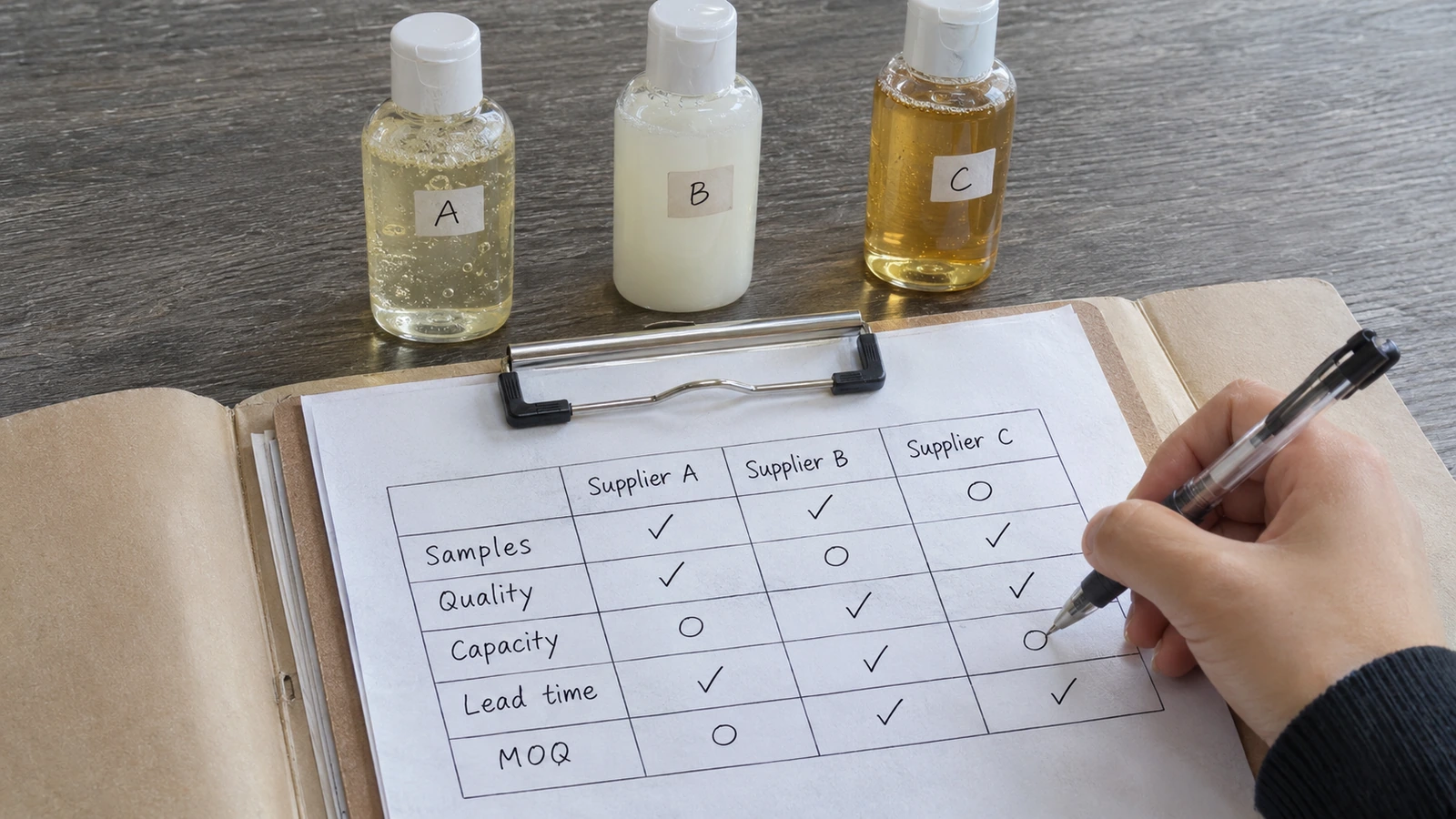
Clarify product and packaging requirements before evaluating OEM/ODM manufacturers.
2. What Should You Verify About a Manufacturer’s Capabilities?
A manufacturer’s real capability is the combination of suitable equipment, relevant experience, technical support and a repeatable way of controlling production. Ask about the product types the factory actually makes, not just the broad categories shown on its website.
Look for relevant product experience
Ask whether the supplier has handled products with similar viscosity, dispensing requirements, packaging format or process conditions. For example, a pump bottle, a foaming dispenser and an aerosol can each introduce different filling and component requirements. Experience with a neighboring product category is useful, but the factory should be able to explain what changes when the format changes.
Ask how development and production are connected
A capable partner should be able to explain how it moves from a brief to samples, how it records approved formula versions, how packaging compatibility is considered, and how the approved product specification is transferred into production. You are looking for a clear process, not a promise that every request is easy.
Check the quality system behind the equipment
Ask how raw materials and packaging components are identified, how production batches are documented, how in-process and finished-product checks are handled, and how deviations or complaints are investigated. ISO 22716 provides guidelines for cosmetic Good Manufacturing Practices covering production, control, storage and shipment. It is a useful reference for discussing a factory’s quality system, rather than a substitute for checking how the supplier actually operates.
If the project targets the EU, Article 8 of Regulation (EC) No 1223/2009 requires cosmetic product manufacture to comply with good manufacturing practice. Ask the supplier to explain the applicable system and provide relevant evidence for the specific site and scope, then confirm the requirements for your own product and market.
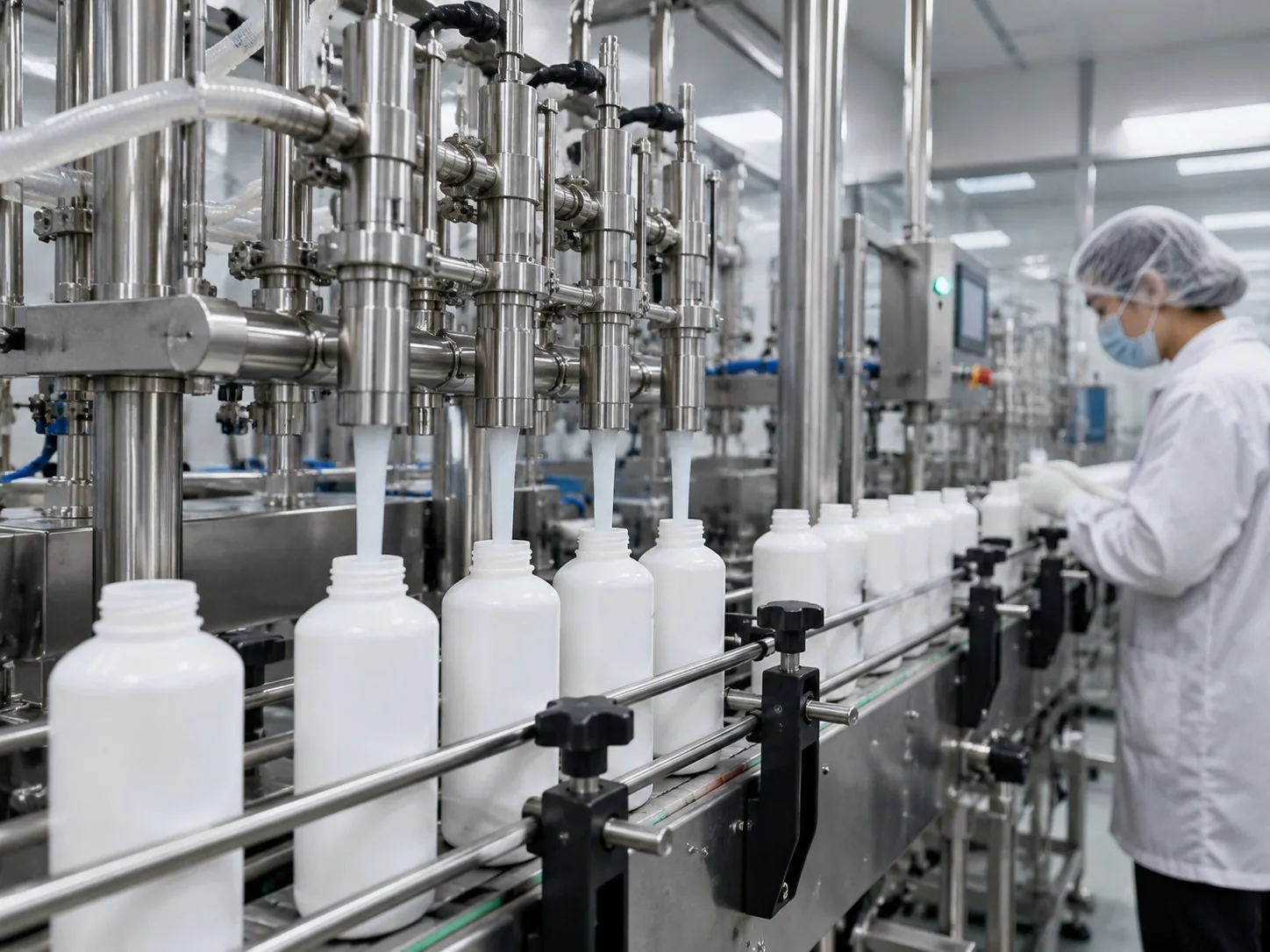
Check whether the manufacturer has production equipment suited to your product type.
3. How to Evaluate Samples, Quality and Documentation
A sample is the beginning of evaluation, not the end of it. It helps you judge appearance, fragrance, texture, dispensing and use experience. It does not by itself prove that the same result can be reproduced across a commercial batch.
Evaluate the sample against an agreed brief
Review the product against the intended specification rather than relying only on whether you personally like it. Record the approved version, the requested changes and the reason for each change. If you are reviewing a pump or spray, test the component as well as the formula: dispensing, leakage, priming, spray pattern and user experience can affect the final product.
Ask for records that answer a specific question
Different documents serve different purposes. A product specification defines agreed characteristics; a Certificate of Analysis (COA) reports specified results for a material or batch; a test report records the scope and outcome of particular tests; and manufacturing records support batch traceability. Ask what each document covers, which product or batch it refers to, and whether it is relevant to the version you are buying.
For quality review, useful questions include: How are incoming materials identified? What checks are performed during production? How are finished goods released? Are batch codes traceable? How are out-of-specification results, complaints and corrective actions handled? The answers should be consistent with the documents and the actual process you can observe.
For EU projects, the applicable cosmetic safety and product-information requirements must be addressed by the responsible parties. For US projects, MoCRA introduced facility registration and product-listing requirements for parties subject to them. These market obligations are not replaced by a factory’s general quality certificate; agree early who will provide information and who will complete each required task.

Evaluate samples alongside the manufacturer’s quality-control process.
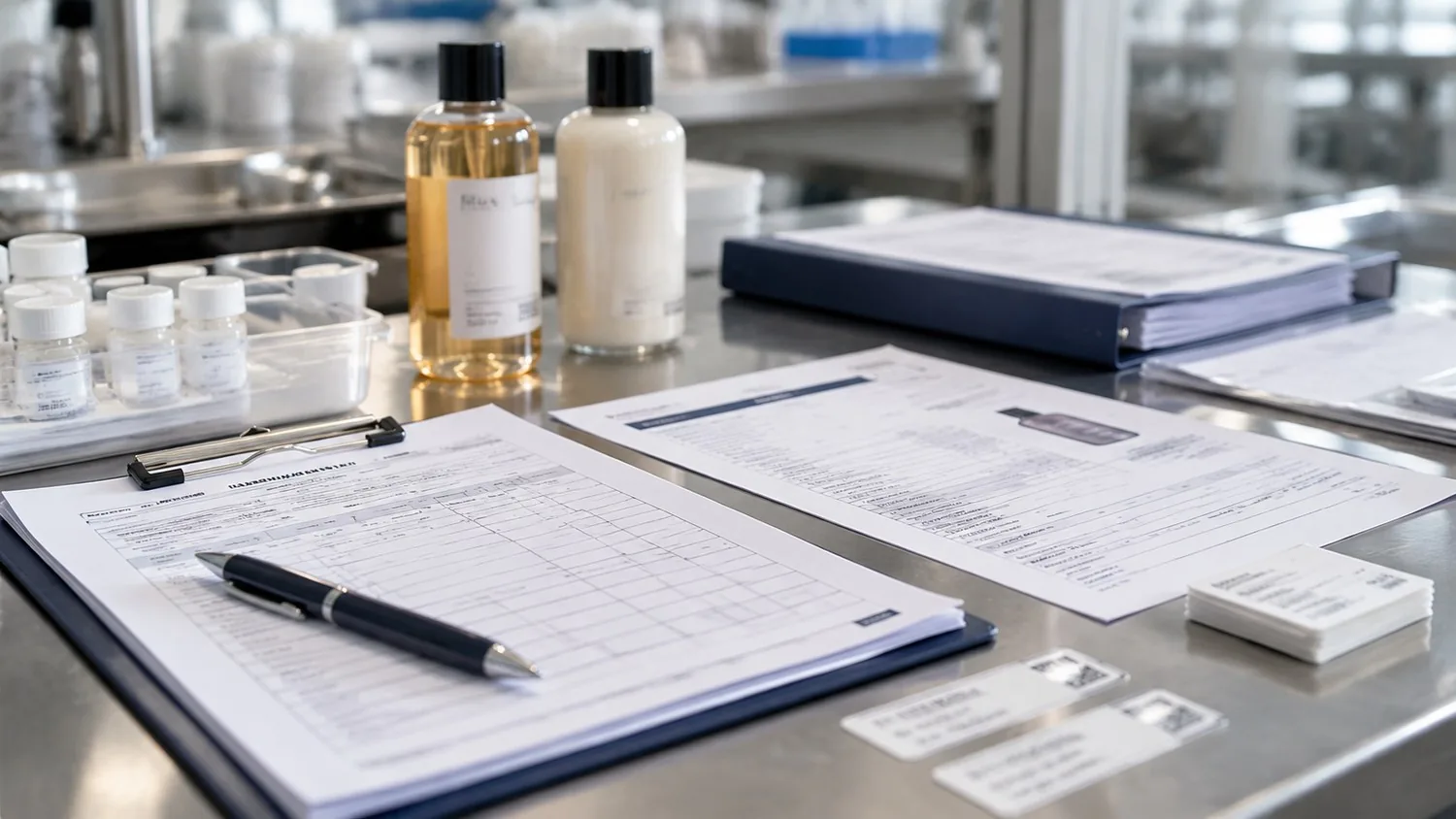
Review specifications, batch records and product documentation as part of supplier evaluation.
4. How to Compare Quotations, MOQs and Lead Times
A supplier comparison only works when the quotations cover the same thing. One price may include a stock bottle, standard label and basic packing; another may include a more expensive component, custom decoration or additional testing. The lower number is meaningful only after the scope is aligned.
| Compare this | Questions to ask |
|---|---|
| Formula and product specification | Are the requested texture, fragrance, performance requirements and approved formula scope the same? |
| Primary packaging | Are bottle or can material, capacity, pump or valve, cap and component quality comparable? |
| Decoration and secondary packaging | Are label, direct printing, carton, shrink film, inserts and other requested finishes included? |
| MOQ and purchasing conditions | Does the minimum apply to the finished product, the formula batch, the packaging components, or each SKU? |
| Testing and documents | Which tests, samples, specifications and market-support documents are included or quoted separately? |
| Delivery basis and timeline | When does the lead time start, which approvals or materials must be ready, and what shipping or handling is included? |
MOQ is shaped by more than the factory’s preference. The batch size, filling-line setup, production schedule and supplier minimums for bottles, pumps, valves, labels or cartons can all affect the practical order quantity. Ask the manufacturer to separate the minimums that apply to the product from those imposed by packaging suppliers.
Lead time also needs a clear starting point. Is it counted from deposit, final formula approval, signed packaging artwork, arrival of all components, or completion of required testing? Development, packaging procurement, production and shipping are separate stages. A realistic timeline states its assumptions instead of presenting one attractive number without context.
Compare the full project cost and conditions—not only the unit price. Include any development, tooling, testing, inspection, freight, duties or other charges relevant to your purchase, and ask the supplier to identify exclusions in writing.
5. What Can a Factory Visit or Video Audit Reveal?
A visit or live video walkthrough can help connect a supplier’s claims with its actual operation. It does not need to be a theatrical tour. Focus on areas that matter to your product and ask the people responsible for each process to explain what happens there.
- Production: Does the equipment shown match the product format and filling process being proposed?
- Materials and storage: Are raw materials and packaging components identified and managed in an organized way?
- Quality control: Is there a defined area and process for sampling, inspection and recording results?
- Traceability: Can staff explain how a finished batch is linked to its production and material records?
- Finished goods: Are released products identified and stored in a way that supports order control and shipment preparation?
- People and communication: Can the relevant team answer practical questions about development, production changes and quality issues?
If an in-person visit is not practical, request a live walkthrough of the relevant areas and a follow-up discussion with the technical or quality contact. A prepared video can be useful for orientation, but a live session gives you a chance to ask for details and understand how the process works.
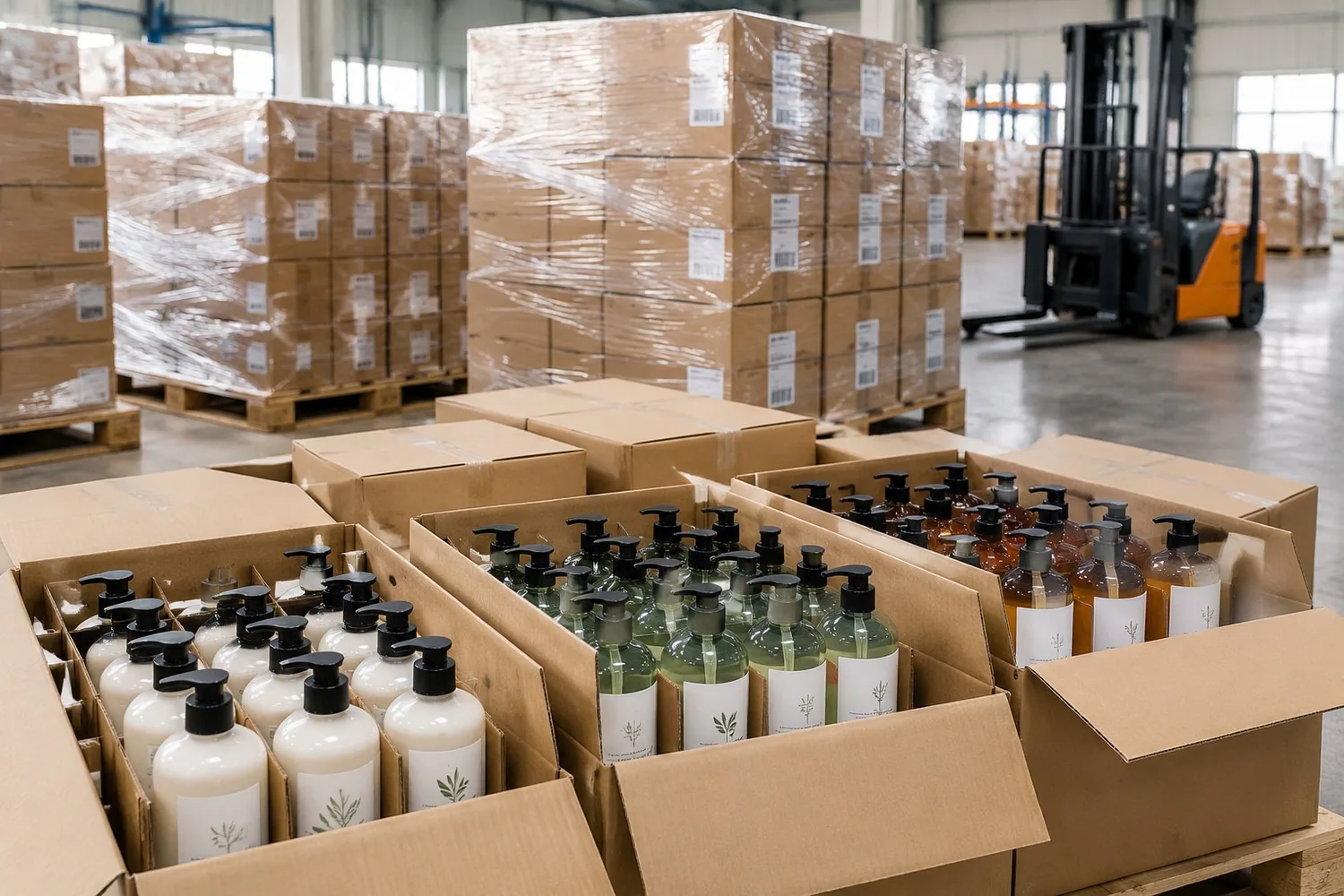
Check how finished products are packed and prepared for shipment.
6. Red Flags and Fair Evaluation
The most useful warning signs are specific and verifiable. A difference in factory size, presentation style or response speed is not automatically a problem; unclear answers about the actual product, inconsistent records or unwillingness to define responsibilities deserve more attention.
| What you notice | What to do next |
|---|---|
| The supplier says it can make almost any product but cannot explain the process for yours. | Ask for a product-specific feasibility discussion and examples of comparable formats or processes. |
| The quotation is much lower but the specification is vague. | Request a written scope covering formula, packaging, testing, packing, delivery and exclusions. |
| Documents do not clearly identify the site, product, batch, scope or date. | Ask for clarification and verify the document with its issuer when appropriate. |
| The supplier presents an “FDA-approved factory certificate.” | Clarify exactly what the document is. FDA states that facility registration and cosmetic product listing are not an FDA approval program, and FDA does not issue certificates verifying compliance with those registration/listing requirements. |
| Formula, component or supplier substitutions are treated as informal changes. | Agree a written change-notification and approval process before production. |
| No one can explain who owns the formula, artwork, tooling or test records. | Set out ownership, license rights, permitted use, confidentiality and transfer arrangements in the contract. |
| The delivery date is promised before the formula, packaging or order scope is settled. | Ask for a milestone-based timeline with the assumptions and dependencies made explicit. |
A useful reference point for US projects is the FDA’s official explanation of cosmetic facility registration and product listing. The agency states that these submissions are not an approval program and that it does not issue certificates or other documents to verify compliance with those registration and listing requirements. A registration number should therefore not be presented as proof that FDA has approved a factory or its products.
7. Build a Supplier Comparison Checklist
When several suppliers remain under consideration, put the evidence in one place. A simple comparison matrix helps separate a persuasive sales conversation from a supplier that can meet the project’s real requirements.
| Evaluation area | Evidence to record | Score (1–5) |
|---|---|---|
| Product fit | Relevant product formats, process requirements and customization scope | ___ |
| Development support | Brief review, sample iteration, version control and technical communication | ___ |
| Quality system | Specifications, batch records, inspections, traceability and issue handling | ___ |
| Documentation | Relevant and clearly scoped quality, testing and market-support records | ___ |
| Packaging and sourcing | Component options, compatibility support, supplier minimums and change control | ___ |
| Commercial clarity | Comparable quotation scope, MOQ, payment terms, exclusions and lead-time assumptions | ___ |
| Project management | Response quality, decision ownership, milestone visibility and escalation path | ___ |
| Contract and continuity | Formula and tooling rights, confidentiality, substitutions and transfer arrangements | ___ |
Use the scores to organize discussion, not as a universal pass/fail standard. A supplier with a lower total score may still be the better fit if it is particularly strong in the capabilities your product depends on. Equally, a serious gap in a critical area—such as aerosol capability for an aerosol project or the documentation needed for a target market—should not be hidden by a high score elsewhere.
Before placing an order, make sure the approved sample, product specification, packaging artwork, agreed quality criteria, order quantity, delivery terms and change-control process are documented. These details are the bridge between choosing a supplier and managing a successful project.
Frequently Asked Questions
Should I choose the largest cosmetic manufacturer I can afford?
Not necessarily. Choose a manufacturer whose equipment, experience, order-size flexibility, technical support and quality system match your product and business stage. Factory size alone does not prove suitability.
Is a GMP or ISO 22716 certificate enough to approve a supplier?
No single certificate replaces a product-specific assessment. Verify the document’s issuer, scope, site and status, then review the manufacturer’s actual production controls, records and experience with the relevant product format.
What is the difference between a COA and a product test report?
A COA reports specified results for a material or batch under its stated scope. A product test report records the particular tests performed and their results. Neither document should be interpreted beyond the product, batch, method and scope it identifies.
Can a manufacturer guarantee a fixed MOQ or lead time?
MOQ and timing depend on the formula batch, packaging supplier minimums, production scheduling, customization and approvals. Ask for the assumptions behind the quotation and timeline, and confirm them in writing.
What should I send when requesting an OEM/ODM quotation?
Start with the product category, target market, intended performance and texture, packaging direction, estimated order quantity, target price range and launch timing. Mark which requirements are fixed and where you welcome the manufacturer’s recommendation.
Should the manufacturer own the formula developed for my brand?
That depends on the development model and commercial agreement. Clarify pre-existing formulas versus project-specific development, ownership or license rights, exclusivity, permitted use, confidentiality and transfer rights before committing.
Conclusion: Choose Evidence, Not Just Promises
A suitable OEM/ODM partner is not simply the factory with the lowest quotation, the largest showroom or the longest list of certificates. It is the supplier whose capabilities fit your product, whose quality and documentation practices can be understood, whose quotation is transparent, and whose team can manage decisions and changes through production.
Before reaching out, prepare a concise product brief and a realistic view of your target market, packaging, quantity and budget. Ask each shortlisted manufacturer the same core questions, compare evidence rather than presentation alone, and document the key decisions before moving into bulk production.
| Planning a hair or body care OEM/ODM project? Share your product category, target market, customization requirements, packaging direction and expected order quantity. These details help establish a practical starting point for a manufacturing discussion. |
|---|
References
The following official sources support the manufacturing-practice and regulatory points discussed in this article.
- International Organization for Standardization — ISO 22716:2007, Cosmetics — Good Manufacturing Practices. Official ISO standard page
- European Union — Regulation (EC) No 1223/2009 on cosmetic products, Article 8 on Good Manufacturing Practice. Official EUR-Lex text
- U.S. Food and Drug Administration — Registration & Listing of Cosmetic Product Facilities and Products, including the agency’s clarification that registration and listing are not FDA approval. Official FDA page
- U.S. Food and Drug Administration — Modernization of Cosmetics Regulation Act of 2022 (MoCRA). Official FDA overview